Guide
Safe Internal Temperature for Chicken in an Air Fryer
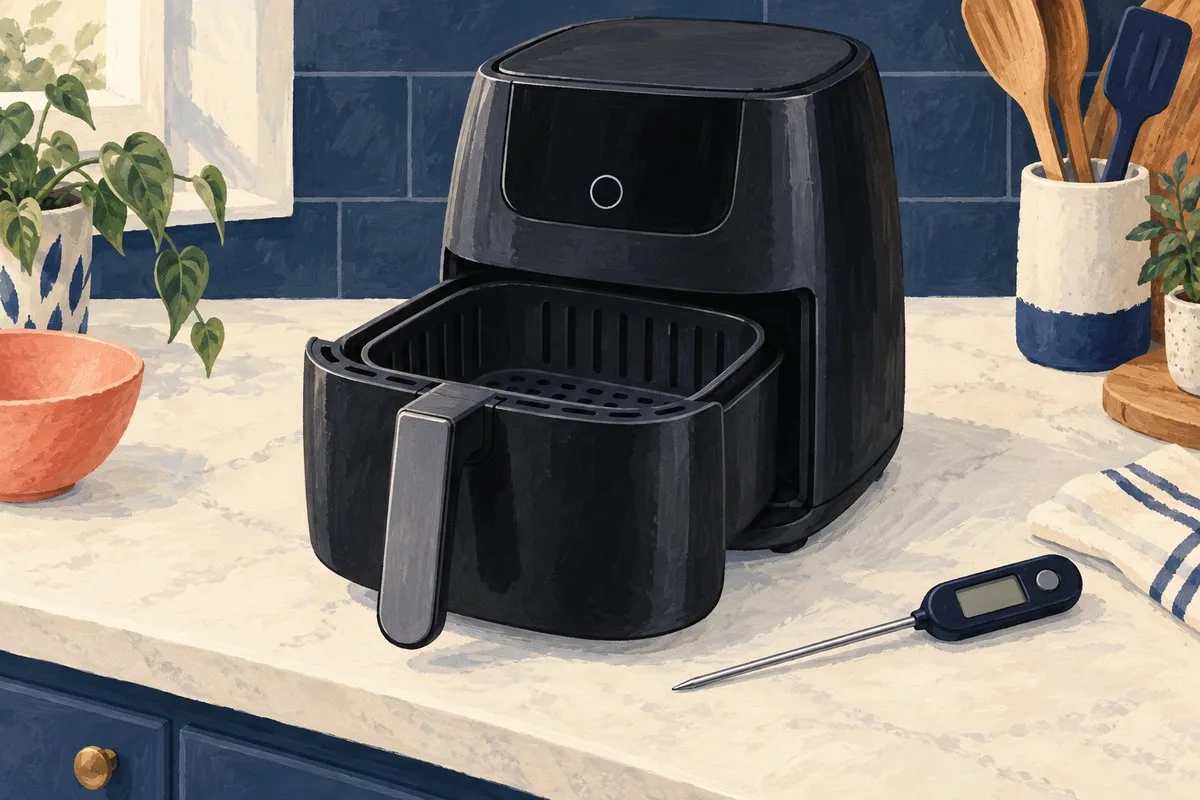
Chicken is safe to eat when the thickest part of the meat reaches an internal temperature of 165 °F (74 °C), measured with a thermometer — and cooking it in an air fryer changes nothing about that number. What the air fryer does change is how fast you get there and how convincingly the outside lies to you along the way. Fast-moving hot air browns and crisps a chicken thigh in a few minutes, so a piece can look finished while the center is still well short of safe, and a slim breast can race past the target and turn chalky while you are still admiring the color. This page is our editorial read on how to use that one number reliably in a small basket: what it applies to, where to put the probe, which cuts benefit from going further, and when to pull.
- Start checking a few minutes before the recipe's stated time, since basket loads and cut thickness vary more than cook times suggest.
- Pause the machine and lift the piece out onto a plate rather than probing inside the hot basket.
- Push a thin instant-read probe into the thickest part of the meat, angling away from bone, and stop when the number stops falling.
- Read the lowest value the probe passes through; that is the center of the piece.
- Repeat on a piece from the middle of the load or the lower rack, where heat reaches last, and treat the lowest of all readings as the batch temperature.
- If any reading is below 165 °F (74 °C), return everything to the basket for one to two minutes and check again.
- Once every piece is at or above 165 °F (74 °C), wash the probe tip in hot soapy water, then rest the chicken briefly and uncovered before serving.
165 °F (74 °C) Is the Number — For Every Cut and Every Appliance
The safe internal temperature for chicken is 165 °F (74 °C). It is the same for breast, thigh, drumstick, wing, tenders and ground chicken, and it is the same whether the heat comes from an air fryer, a conventional oven, a grill or a skillet. Appliances differ in how they deliver heat; the biology of the meat does not care which one you used.
The most common confusion in air frying is mixing up two temperatures that live in the same recipe. The number on the dial — often somewhere between 350 °F and 400 °F — is the air temperature inside the basket. The 165 °F figure is the temperature of the meat itself, read at its coldest point. Setting the basket to 165 °F does not cook chicken safely; it just cooks it slowly at a temperature the meat may never comfortably exceed.
The target also applies to things that are not obviously 'a piece of chicken': ground chicken patties and meatballs, chicken sausages, rolled or stuffed breasts, and leftovers being reheated. With stuffed or rolled pieces, the filling counts as part of the food — probe through into the center of the stuffing, not just the muscle wrapped around it.
- 165 °F (74 °C) — the reading you want in the thickest part of any chicken cut.
- The number describes the meat, never the dial or the preheat setting.
- Ground chicken and chicken patties: same target, probed through the side into the middle.
- Stuffed or rolled pieces: measure the filling as well as the meat.
- Leftovers reheated in the basket: bring them back to the same target, not just 'warm through'.
Why Air-Fried Chicken Looks Done Before It Is — and Sometimes After
An air fryer is a small convection oven with an aggressive fan. Moving air strips moisture from the surface quickly, and a dry surface browns far sooner than a damp one. That is exactly why skin crisps so well in a basket, and exactly why appearance is a poor doneness signal here: deep golden color can appear minutes before the center catches up, especially on bone-in thighs, drumsticks and thick breasts.
The classic visual tests fail in both directions. 'Juices run clear' is unreliable — juice color depends on how much pigment has leached out and how the bird was chilled, not on whether pathogens have been dealt with. Pink meat near the bone is also a weak signal: pigment from the bone and marrow can tint the surrounding meat and stay pink even when the piece has passed the safe temperature. Marinades containing acid, and rubs heavy in paprika or other red spices, can hold a pinkish tone at the surface for the same non-safety reasons.
The reverse is just as common. A thin cutlet or a tender can hit target while the outside is still pale, because there is very little mass to heat. Pulling it early because it 'doesn't look ready' undercooks it; leaving it in until it looks like a photograph overcooks it. In a basket, the thermometer is not a formality — it is the only honest instrument you have.
- Crisp skin is a surface event; it says nothing about the center.
- Clear juices are not a doneness test.
- Pink near the bone can persist in fully cooked chicken.
- Pale thin cuts can already be at target — check before adding time.
Where to Put the Probe in a Small, Crowded Basket
Aim for the thickest part of the piece and stop the tip in the middle of that mass. Push the probe in slowly and watch the reading fall and rise — the lowest number you pass through is the true center. If the reading climbs steadily to the far side, you went too far and are now reading the hot outer layer.
Bone conducts heat differently from muscle and will give you a falsely high number, so keep the tip clear of it. On a drumstick, enter from the side toward the meaty middle and angle away from the bone. On a bone-in thigh, come in from the top at a slant. On a boneless breast, enter the thick end and travel along the length of the piece rather than straight down through a thin section.
Lift the food out onto a plate before probing whenever you can. Measuring inside a hot basket exposes your hand to the element and lets radiant heat influence the probe, and a tip resting against the metal basket reads the basket, not the chicken. Finally, remember that air fryers have cold spots: pieces in the middle of a crowded load, or on the lower level of a stacked rack, lag behind the ones on the outside. Check more than one piece and let the coldest reading decide when the batch is finished.
- Thickest part, tip in the center, probe pushed in slowly.
- Stay off bone, gristle and large fat seams.
- Never let the tip touch the basket or a rack.
- Probe from the side on thin cuts, from the end on breasts.
- Check several pieces; the lowest reading governs the whole batch.
Pull Temperatures by Cut: Safe Is Not Always Ideal
165 °F (74 °C) is the safety floor. For white meat it is also, in our assessment, close to the ceiling: chicken breast loses moisture rapidly above it, and every extra minute in fast-moving hot air makes that worse. Breasts and tenders reward attention — start checking well before the recipe time is up, and take them out as soon as the center reaches target.
Dark meat behaves differently. Thighs, drumsticks and wings carry more connective tissue and fat, and many cooks deliberately take them further — commonly into the 175–185 °F (80–85 °C) range — because that connective tissue softens with additional heat and the meat turns tender rather than dry. That is a texture choice, not a safety requirement; the safety line was already crossed at 165 °F.
Whole small birds and half-chickens are the hardest case for a basket, because breast and thigh want different endpoints and the geometry is uneven. There, the practical approach is to probe both the deepest part of the breast and the thigh joint area, and to accept that whichever region reads lowest sets the schedule.
- Breast, tenders, cutlets: pull at target, not past it.
- Thighs, drumsticks, wings: safe at target, often better with more time for texture.
- Ground chicken patties: target, then rest briefly before serving.
- Whole or half birds: probe breast and thigh separately, trust the lower number.
Carryover, Resting and When to Take It Out
Meat keeps cooking after it leaves the heat because the hot exterior continues to drive heat inward. That effect scales with mass: a large roast can climb noticeably while it rests, but an air-fried tender or a single boneless thigh has very little thermal inertia and will gain only a small amount. This is why 'pull it early and let carryover finish the job' is bad advice in an air fryer for small pieces — the carryover simply may not be there.
The practical routine is to check a few minutes before you expect to be done, and to keep checking. If a piece reads under target, returning it to the basket for another minute or two costs almost nothing, because the appliance is still hot and recovers immediately. If it reads over, there is no remedy.
Resting still helps. A few minutes off the heat lets juices redistribute, so less liquid escapes on the first cut. The tradeoff is textural: skin that was crackling straight out of the basket softens as steam works its way back to the surface. For very crisp results, we would keep the rest short and serve promptly, uncovered rather than tented, so the surface does not steam itself flat.
- Small pieces gain only a little after leaving the basket — do not bank on it.
- Start checking before the stated time, then re-check every couple of minutes.
- Under target is fixable; over target is not.
- Rest uncovered and briefly if crisp skin matters more than maximum juiciness.
Thermometer Habits That Make the Number Trustworthy
A safe-temperature rule is only as good as the instrument enforcing it. A thin-tipped instant-read thermometer suits air frying best: the smaller the probe, the smaller the hole it leaves and the faster it settles, which matters when you are holding a basket open and losing heat. Slow dial-face thermometers left in place through a whole cook are a poor match for a compact basket, where the probe often sits close to the element and reads air rather than meat.
Check your thermometer occasionally rather than assuming it is right. An ice-water slurry should read 32 °F (0 °C), and vigorously boiling water should read close to 212 °F (100 °C) at sea level — lower at altitude. If either reading is off, either calibrate the unit if it supports it or mentally correct for the offset. A thermometer that is quietly reading several degrees high is worse than no thermometer, because it converts a guess into false confidence.
Hygiene matters at the moment of measurement. A probe that has been in raw chicken and is then used on cooked food carries bacteria across, so wash the tip with hot soapy water between the check that finds the food underdone and the one that confirms it is finished. Keep raw chicken cold until it goes in the basket, get cooked leftovers back into the refrigerator promptly, and avoid leaving cooked chicken sitting out in the 40–140 °F (4–60 °C) band for long, since that is where the trouble happens.
- Thin-tipped instant-read probes suit small baskets best.
- Verify against ice water and boiling water now and then.
- Wash the probe tip between checks on undercooked and finished food.
- Keep chicken out of the 40–140 °F (4–60 °C) band for as short a time as practical.
Frequently Asked Questions
Does chicken need a different internal temperature because it is air fried?
No. The safe internal temperature is 165 °F (74 °C) regardless of the appliance. The air fryer only affects how quickly the center gets there and how the surface looks when it does — the target itself is unchanged.
My chicken hit 165 °F but is still pink near the bone. Is it safe?
Pink coloring next to the bone is common in fully cooked chicken, especially in younger birds, and comes from pigment rather than from undercooking. If the thickest part of the meat has reached target on a thermometer you trust, the temperature is the answer, not the color.
Should I set my air fryer to 165 °F?
No — that is the temperature of the meat, not the air. Cooking at 165 °F air temperature would take a very long time and would not crisp anything. Use the temperature your recipe calls for on the dial, and use a thermometer to judge the meat.
Do thighs and drumsticks really need to go above the safe temperature?
They do not need to for safety; they are safe at 165 °F (74 °C). Many cooks take dark meat further, commonly toward 175–185 °F (80–85 °C), because the connective tissue softens with extra heat and the texture improves. That is a preference, not a food-safety step.
How do I handle reheating cooked chicken in an air fryer?
Treat it like the original cook: bring the center back to 165 °F (74 °C) rather than stopping when the outside feels hot. Thick pieces reheat unevenly in a basket, so probe the middle, and consider slicing large portions so the center is not far from the surface.
Can I cook chicken straight from frozen in an air fryer?
Some cuts can be cooked from frozen, but it takes considerably longer and the temperature gradient is steeper, so the surface can be well browned while the middle is still cold. Check the center in more than one spot, and expect to add time in short increments until every piece reads at least 165 °F (74 °C).
Related guides